
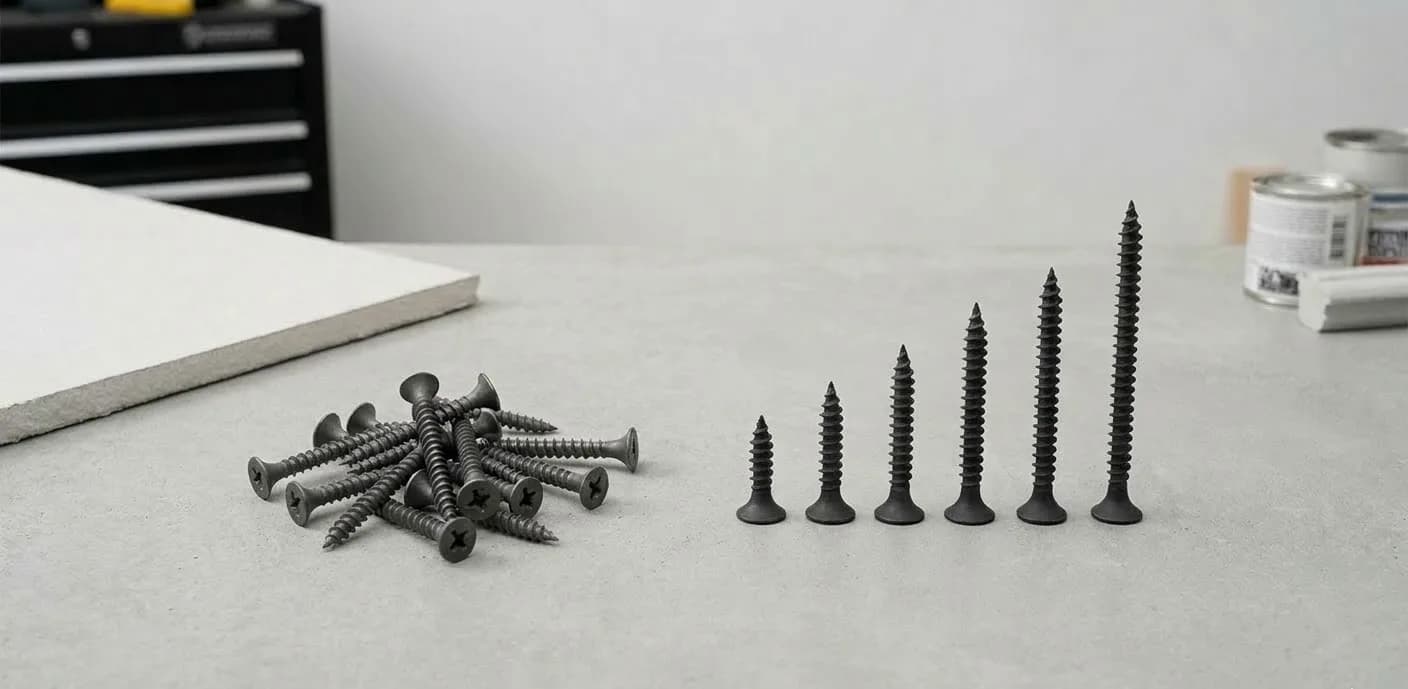
Drywall construction is an art of precision, but even the most beautiful job can fall apart if you use the wrong screw. Many people tend to confuse a standard drywall screw with a self-drilling metal screw. Choosing the wrong one can lead to board breakage, rust, or simply an unstable structure. In this guide, we’ll clear up the confusion.
Quick Summary
- Drywall screw (sharp point): Designed for fastening drywall board to thin metal studs or wood.
- Metal screw (self-drilling point): Designed for fastening thick metal profiles or metal-to-metal elements.
- Screw embedment depth: Make sure the screw penetrates at least 10 mm into the stud.
What is the essential difference between the screw types?
The main difference lies in the tip of the screw. A standard drywall screw comes with a sharp point designed to pierce the soft board and enter thin sheet metal (up to 0.9 mm). A metal screw, on the other hand, has a drill-like tip that lets it drill its own hole in thicker metal without pre-drilling. Using a self-drilling screw on sheet metal that is too thin may 'chew up' the hole and cause the screw to spin freely.
Pro tip
When driving drywall screws, make sure the screw head sinks about 1 mm into the board, but without tearing the outer paper layer. Torn paper means the screw is no longer holding the board!
Technical comparison: drywall screw vs. metal screw
| Characteristic | Drywall screw (black) | Metal screw (self-drilling) |
|---|---|---|
| Tip type | Sharp point | Drill point |
| Primary use | Attaching board to stud | Metal-to-metal fastening / thick studs |
| Coating | Black phosphate (corrosion-resistant) | White / yellow zinc |
| Drilling capacity | Up to 0.9 mm sheet metal thickness | Up to 2.5 mm sheet metal thickness |
📋How do you properly screw into a drywall wall?
Choose the right length
For a standard drywall board (12.5 mm), use a screw at least 25 mm long.
Set the screwdriver correctly
Use an impact driver or a drywall screw gun with a depth stop (clutch) to prevent driving too deep.
Spacing
Maintain a distance of about 20–25 cm between screws along the stud.
Frequently asked questions
Can I use a metal screw to fasten drywall board?
You can, but it is not recommended on standard thin studs. The head of a metal screw is usually wider and may damage the board, and the drill tip may create a hole that is too large in a thin stud.
Why are drywall screws usually black?
The black color comes from a phosphate coating. This coating protects the screw from rust that can form due to the moisture in the joint compound and paint applied to the drywall.
Conclusion
Choosing correctly between a drywall screw and a metal screw is the difference between a stable wall and amateur work. Remember: for thick construction — metal screws; for the drywall boards themselves — standard drywall screws. Need a supply of quality screws for your next project?